Top pick
Solo
A home pooja or small satsang.
Maharashtra · Festival Bhajans & Aartis
Maharashtra’s festival calendar is built around gatherings.
Planning notes
Ganeshotsav fills ten days with mandal stages and aarti, and it ends in processions to the water; Navratri brings garba grounds in Mumbai’s Gujarati neighbourhoods and devotional evenings at the Mahalaxmi temple in Kolhapur; Gudi Padwa is marked by processions in Dombivli and Girgaon; the Wari to Pandharpur is a long, sung pilgrimage. Societies and mandals look for singers who can lead the crowd rather than perform at it.
The bhajan and aarti sets use tunes the crowd already knows, so a street or a society compound can sing together. Within the Mumbai region there is no outstation journey. For Pune, Nashik, Kolhapur and the other cities the band goes the day before. Processions follow routes and timings set with the authorities, and the music is planned around those stops.
The calendar is fixed by the festival, so the booking is fixed by the festival date. Message as soon as the mandal’s programme is known; the best evenings go first.
Planning notes for Maharashtra
Festival dates follow the lunar calendar, so enquire as soon as yours are known.
A stage in a tight lane needs speakers aimed along the road rather than into the buildings.
Processions follow fixed routes and times, so plan the music around the pauses.
On location
Getting the music there
Mumbai, Thane, Navi Mumbai and Vasai-Virar need no travel. Pune, Nashik and Alibaug are a road trip away, while Nagpur and Chhatrapati Sambhajinagar are usually reached by air.
See and hear it
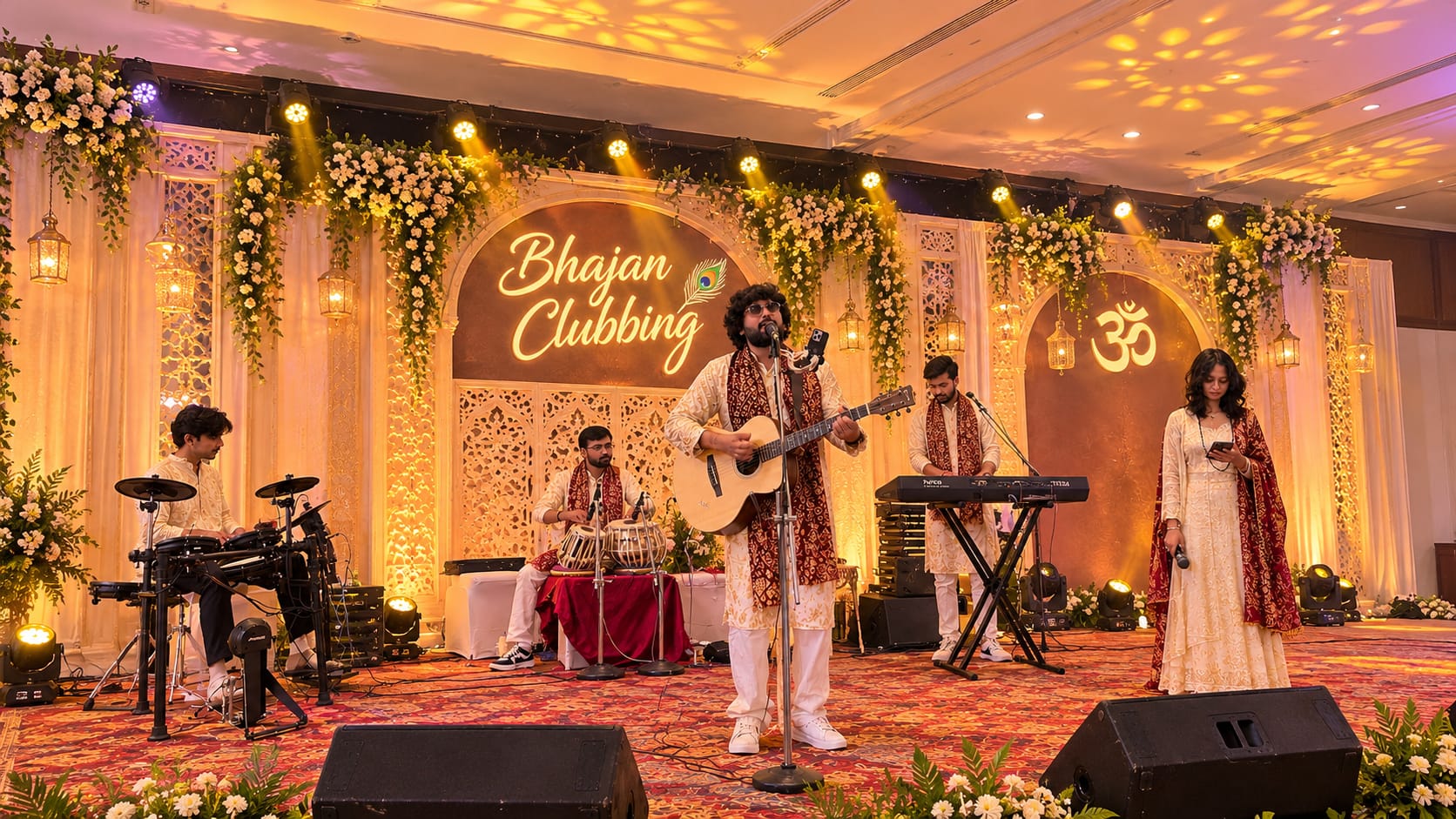
Photos and reels are from Dharmik’s own shows. The songs below are the ones people ask for most at live music for a festival bhajan evening in Maharashtra.
Tap a tile to watch or enlarge. The full gallery
Often asked for
A sample; the repertoire is on the media page.
Why Dharmik
Correct expression and feeling in every bhajan and aarti.
Simple refrains and call-and-response bring everyone in.
Song selection follows the deity, the occasion and the community.
Formats
Top pick
A home pooja or small satsang.
3 musicians
Voice, melody and percussion for society programmes.
4 musicians
Larger festival and jagran evenings.
How the night unfolds
A short devotional opening.
Familiar bhajans with simple refrains.
A collective closing aarti.
How it works
Send the occasion, the date, the city, the venue and the number of guests on WhatsApp, or call. There are no forms to fill in.
Availability, the format that suits the room, from a solo singer to a full band, and the fee are agreed together. An advance holds the date.
Songs, timings, sound and power are settled in writing. For events away from the main office in Virar West, travel and stay are agreed here too.
The musicians arrive early, check the sound and perform. For remote events a short test session runs before the live stream.
Visit us
Main office · Maharashtra
Rajkot
Shop No. 324, Chandreshnagar Main Road, Mayani Chowk, Rajkot, Gujarat 360004 DirectionsDwarka
T.V. Station Area, Patel Samaj Road, Dev Bhumi Dwarka, Dwarka, Gujarat 361335 DirectionsPorbandar
Meera Shopping Center, First Floor, Kedareshvar Road, Porbandar, Gujarat 360575 DirectionsAhmedabad
Swaminarayan Park-1, Opp. Swaminarayan Park-2, New Vasna, Vishala, Ahmedabad, Gujarat 380007 DirectionsEach Maharashtrian festival has its own songs. Ganeshotsav asks for the Ganpati aartis, above all Sukhkarta Dukhharta, sung every evening for ten days. Navratri asks for the aartis and bhajans of the goddess, in Kolhapur and Tuljapur especially. The Wari to Pandharpur is a pilgrimage of abhangs, the devotional verses of Tukaram, Dnyaneshwar and other saints, and Gudi Padwa is a day of processions and cheerful songs. Diwali asks for the Lakshmi aarti.
A singer who knows the order and the words of each, and who can keep a crowd in time, is a gift to a mandal.
A booking begins with the date and the venue: a street, a society compound or a temple courtyard. The mandal then agrees the hour with the police and the municipality and tells the singer the number of people and the programme. The singer shares a draft list, and the sound is planned for the crowd.
For the large festivals, the best dates are taken weeks ahead, and travel outside Mumbai adds a day. Early planning avoids both problems.
The devotional set follows the festival. Ganeshotsav asks for Ganpati aartis and Marathi bhajans; Navratri asks for songs of the goddess such as Jai Ambe Gauri; Janmashtami asks for Krishna bhajans; and Diwali asks for the Lakshmi aarti. Between them, the simple bhajans that every family knows, Vaishnav Jan To and Achyutam Keshavam, keep a crowd singing together.
The set is paced for the stage and the crowd: slow to begin, rising in the middle and ending with the aarti sung by all.
Local FAQs
Yes, aarti and bhajan evenings are one of the services across Maharashtra.
Ganeshotsav, Navratri, Diwali and temple festivals among others; describe the occasion and the audience.
Yes, for Pune, Nashik, Kolhapur and beyond; the plan includes it.
The best-known Ganpati aarti, sung throughout Ganeshotsav.
Yes, for a Wari programme or a bhajan evening.
Several weeks ahead for the big festivals.
Check availability in Maharashtra
No forms, no waiting on email — your message arrives pre-filled with the event details.
Ask about the music
AI assistant · for dates & pricing use WhatsApp